SiteDirectory for SharePoint 2010
SP 2010 does not bring a SiteDirectory template. Microsoft Consulting Services UK have released a CodePlex version of a SiteDirectory for SharePoint 2010: http://spsitedirectory2010.codeplex.com/
What is the Purpose of the Site Directory for SharePoint 2010?
SharePoint 2007 used to have a type of Site Called Site Directory which provided a directory of all sites that had been created. In SharePoint 2010, this feature has been dropped. This solution has been developed to fill the gap in SharePoint 2010. The solution follows the same basic principle of the Site Directory in SharePoint 2007 but adds some commonly requested features.
Do not install Office 2010 x64
Now you will think “Why not?”. Some time ago I read a blog post which said “If you are asking yourself if you want to install Office 2010 as 64bit version, you should install the x86 version”. Why that?
The reason is, that if you are asking yourself you worry about incompatibility with over software. And you are right! If you install x64, all add-ins you use have to be x64 as well. You should however install x64, if you need more than 2GB for Excel :-/ Or you use a SQL Server to store your data and install x86…
2010 available on MSDN
SharePoint and Office are now available via MSDN subscription:
http://msdn.microsoft.com/en-US/subscriptions/subscription-downloads.rss
Update:
Microsoft SharePoint Foundation 2010 (English)
Server Core Roles and Features in 2008 R2
Maybe you’ve already set up a core server. Or you are thinking about it.
Anyway. An overview of the available features for each version of Windows Server 2008 R2 can be found here: http://blogs.dirteam.com/blogs/sanderberkouwer/archive/2010/02/03/server-core-roles-and-features-in-2008-r2.aspx
The table below shows the individual roles and features in fresh Server Core installations of Windows Server 2008 R2, Web (column 1), Standard (column 2), Enterprise (column 3) and Datacenter (column 4) edition. It also lists the Server Roles features in a fresh installation of the special-purpose Hyper-V server 2008 R2. (column 5):
SharePoint 2010 = RTM
As you can read on the SharePoint Team Blog, SharePoint 2010 has reached RTM status.
There is word about availability on MSDN.
Our Volume License customers with active Software Assurance (SA) on these products will be one of the first to receive the 2010 set of products. They will be able to download the product in English, French, Spanish, German, Russian, and Dutch via the Volume Licensing Service Center starting April 27. Other languages will be available on a rolling timeline. Customers without SA will be able to purchase the new products through Volume Licensing from Microsoft partners starting May 1.
Visual Studio 2010 with SharePoint 2010 Beta 2
A quick test shows that the just released Visual Studio 2010 works on my SP 2010 Beta 2 VM.
I could open a project, hit F5 to deploy it and debug successfully.
Working with large lists in SharePoint 2010
What is a large list? What might be the problem if I store 1 million documents in a document library? Is there an improvement from WSS 3 to SharePoint Foundation?
If you want answers to the questions, take a look at a great post at the “Microsoft Enterprise Content Management (ECM) Team Blog”.
A summary to the problem:
Any time you ask for content from SharePoint, you have to specify how it’s sorted – for example, the All Documents view in SharePoint 2007 asks for the top 100 results, sorted by filename. But items aren’t sorted by filename in the SharePoint content database – so, to bring you this view, SharePoint has to gather up all these million items, sort them, and finally display the 100 ones at the top of the sorted list.
Treffen der OWL SharePoint UserGroup
Am 13. April werden wir uns wieder um 18h in Paderborn treffen. (Net at Work Netzwerksysteme GmbH, Am Hoppenhof 32, Anfahrtsbeschreibung).
Als Thema ist ein Erfahrungsbereicht über die Migration von Lotus Domino/Notes nach SharePoint 2007 hören. Vielen Dank schon einmal an Campus Consult.
Wir bitten um eine kurze Anmeldung per Email an ug-owl ( at ) mysharepoint ( . ) de.
Am 12. Mai ist SharePoint 2010 release Termin. Zum weltweiten Launch der neuen SharePoint-Suite hat sich die SharePointCommunity etwas Besonderes überlegt. Es werden die Usergroups aus München, SaarLorLux, Düsseldorf, Berlin, Stuttgart , Friedrichshafen, Hamburg, Stuttgart, Würzburg, Dresden und natürlich wir aus Ostwestfalen an einem SharePointCommunity-Launch teilnehmen. Derzeitig sieht die Planung es so vor, das die Usergroups sich ab etwa 16-16:30 Uhr treffen, damit die Live-Launch-Übertragung von Microsoft ab 17 Uhr gemeinsam verfolgt werden kann. Im Anschluss werden wir eine Live-Schaltung zu den einzelnen Usergrouptreffen machen, um die Gruppengedanken zum Event mit einzufangen.
VMWare and Disk activity on .vmem file
Every time I suspend a VM on my VMWare Workstation, there is a long running disk activity on the associated vmem file. This file is a copy of the virtual machines pagefile running on the host instead of the guest.
Suspending a VM shows a progress bar, which is pretty fast. But even a long time (minutes) after it has vanished, the disk activity still continues.
The setting mainMem.useNamedFile = “FALSE” will configure VMWare to use the host paging file instead of a vmem file. Suspending a VM is much faster. The progress bar is slower, but if it disapears, the disk activity also stops.
The IWebPartField Interface versus the ASP.NET Lifecycle
A Webpart receives a filter value through the IWebPartField interface. The example over at MSDN was simple and clean. So I adopted the code to my Webpart.
A common scenario would be to create controls based on the received filter value. E.g. query a list for the passed filter value, and display the item from the query.
Problem
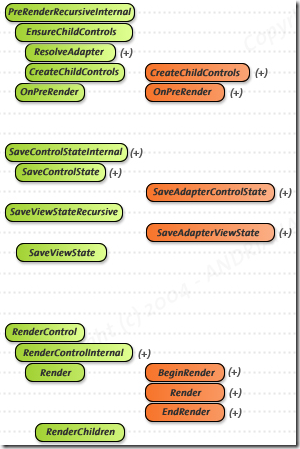
From the ASP.NET Lifecycle we know how to deal with controls. Create them in CreateChildControls, assign values in OnPreRender and let them being rendered in RenderContents. Now we have a problem. The passed value in our Webpart is not available at any place, where we can still add controls to the page. If we try to do in RenderContens, they are not shown. It’s too late.
Which SharePoint version am I running?
Solutions which were developed for SharePoint Services V3 will most likely continue to work if you use them in a SharePoint Foundation environment.
But how do you find out which version your are dealing with? This is a question which might be important if you use V3 CSS elements which are not available under SharePoint Foundation.
The SharePoint version can be found from from the SPFarm.Local.BuildVersion property. For SharePoint V3 you’ll need permissions to access the configuration database to read the local farm. Otherwise it will be null.
Modify Overwrite Policy for an EventLog created by an EventLogInstaller
Developing a Windows Service is a common task. Creating an EventLog for this service also is a common practice. The EventLog can be created with a ServiceInstaller (a class which inherits from System.Configuration.Install.Installer).
This is how an Eventlog can be added during the installation with a custom Installer class:
public Installer()
   {
      Installers.Add(new EventLogInstaller
               {
                  Source = "EventLogSource",
                  Log = "EventLogName"
               });
The EventLogInstaller class does not allow to set the overwrite mode.
2010 RTM date
2010? Which 2010?
Office and SharePoint. They will reach RTM status in April. Availability is May 12th and June for “regular customers”.
PDF iFilter Comparison
Crawling PDF files can be a long running process with the Adobe PDF iFilter. We already knew that.
Jie Li compared 3 iFilters for indexing PDF files.
To make it short, the Adobe iFilter takes roughly about 33 times the time compared to the Foxit iFilter 2 on that particular server.
Shrink SQL log files
Depending on the configuration of you databases, the log files (*.ldf) can be very large. See Selecting a Recovery Model.
Should I continue reading?
If your databases are configured to use the FULL recovery model, the log files are very large and you need some free space, you can use this SQL script to shrink them. So keep on reading 🙂
The script will change the recovery model for a single database to SIMPLE and shrink the log files. At the end it will restore the recovery model to the setting it has been before.